

ZEISS ClearMind Lenses in Abu Dhabi | Optic One
July 11, 2026
How to Order Prescription Eyeglasses Online in the UAE — Step-by-Step Guide
August 2, 2026Lens Guide · Japanese Lens Technology
Tokai Lenses in Abu Dhabi: A Complete Guide to Tokai Lens Designs, Materials & Coatings
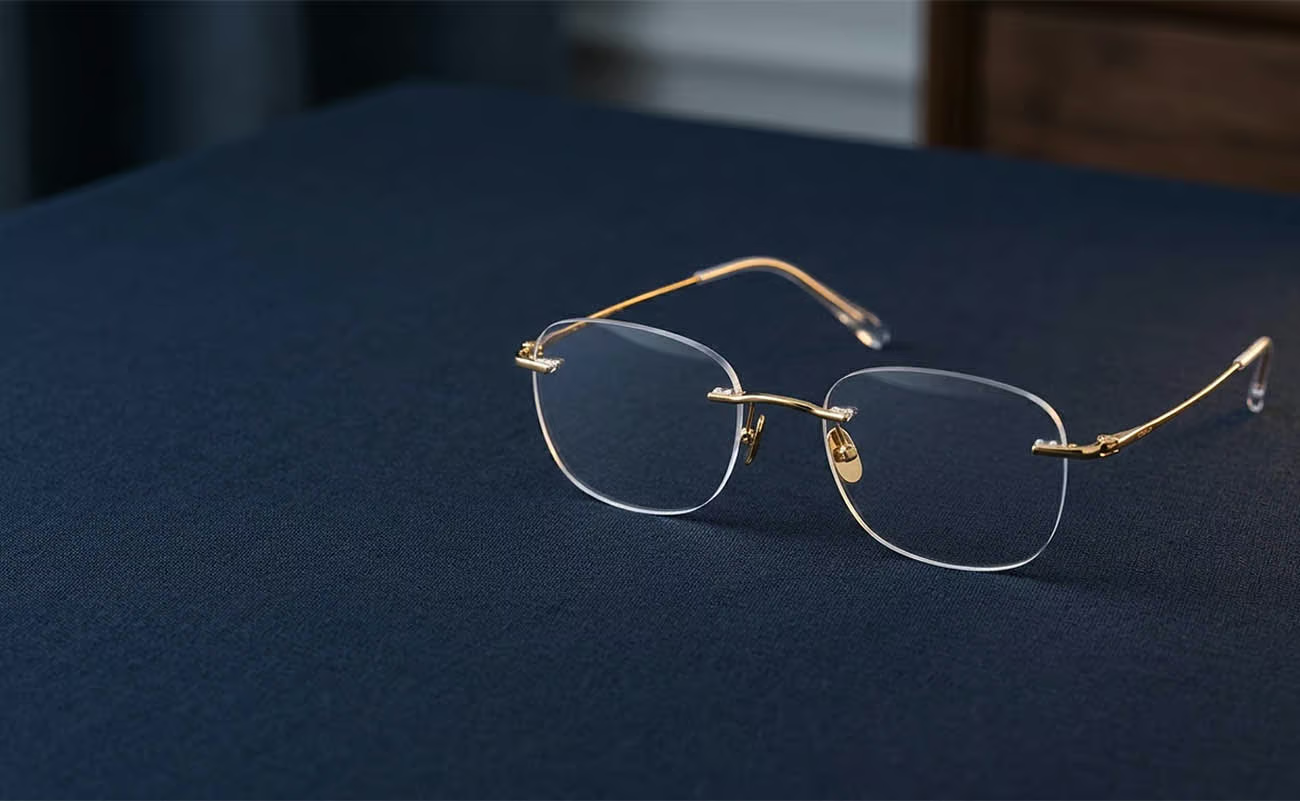
Tokai lenses are premium prescription spectacle lenses from Tokai Optical, a Japanese lens maker founded in 1939. Tokai is known for very thin high-index lenses — including the world’s highest-index plastic lens material, 1.76 — the Lutina eye-protective lens material, neuroscience-based Neuro Select progressive lenses, and some of the most durable lens coatings available. In Abu Dhabi, Tokai lenses are available at Optic One Opticals on Hamdan Street, fitted after a professional eye test and precise measurements.
This guide explains, in plain language, what each Tokai design, material and coating actually does — and who each one suits — so you can walk into a consultation already understanding your options.
Tokai is part of our premium lens range. These are specialist Japanese lenses chosen for specific optical, protective or cosmetic requirements — not our entry-level option. If a simpler lens serves your prescription just as well, we will tell you honestly where extra spend stops adding visible benefit.
Buy one complete pair with Tokai lenses and receive a second complete pair free. Terms and eligibility apply. Please confirm the available lens options with Optic One.
Quick Tokai lens selection guide
Start here. Find the row that sounds like you, then read the matching section below. Final suitability always depends on your prescription, frame and lifestyle — that is what the consultation is for.
| Your need | Tokai technology to ask about | Why it may help |
|---|---|---|
| Strong prescription, thick-looking lenses | High-index 1.67 / 1.70 / 1.76 with an aspheric design (AS, HR or HR-W) | Tokai’s 1.76 is the world’s highest-index plastic lens material — up to 49% thinner than standard 1.50, according to Tokai |
| Reflections in photos and on video calls | NRC — No Reflection Coating | Tokai reports a sensed reflectance of roughly 0.19% — the lens looks almost invisible |
| Worried about scratches | USC — Ultra Shield Coating | Tokai’s tests show around 6× the scratch resistance of a conventional multicoat |
| Long hours in the UAE sun or driving | ESC — Eternal Skin Coating, ideally on Lutina material | UV protection plus a near-infrared cut, over Lutina’s violet-light filtering |
| Long hours on digital devices | Lutina material, or the TBC coating | Lutina filters about 94% of high-energy violet light (400–420 nm) per Tokai |
| Struggled with progressive lenses before | Neuro Select 5X, 7X or 9X | Designs evaluated with brain-activity measurements to reduce blur, distortion and sway |
| Wider near and intermediate vision at work | Neuro Select Town or Home designs, or Tokai indoor lenses | Zone balance shifted toward desk and screen distances instead of far distance |
| Driving and general everyday use | Neuro Select Daily design, or HR single vision | Daily designs prioritise a clear, stable distance view |
| How your eyes look through the lenses | Aspheric or double-sided aspheric designs (HR-W, Bi-AS) in higher index | Flatter, thinner forms reduce the magnified or shrunken look strong prescriptions cause |
| Eye-protective lenses | Lutina single vision, Lutina progressives or Lutina Photo | One material family across most Tokai designs, so you rarely give up Lutina to get the design you need |
Not sure which row is you? Send your prescription on WhatsApp and our optometrist will tell you which Tokai lens and coating actually make sense for your power — no obligation.
What makes Tokai lenses different?
In one line: Tokai is a Japanese lens specialist that competes on optical engineering — thinner materials, brain-science progressive designs and unusually durable coatings — rather than on volume. It makes the world’s highest-index plastic lens material (1.76), the Lutina eye-protective material, and a coating range produced in its own thin-film division.
Tokai Optical was founded in Japan in 1939 and has spent decades focused on ophthalmic lenses, with its own R&D and thin-film coating division. A few things stand out when you compare Tokai with mainstream lens brands:
- The world’s highest-index plastic material. Tokai launched the 1.76 index in 2006 and it remains the highest refractive index available in a plastic spectacle lens, per Tokai’s published comparison of plastic materials. For strong prescriptions, that means visibly thinner, lighter lenses.
- Aspheric design depth. Beyond basic aspheric lenses, Tokai offers back-surface aspheric (HR), double-sided aspheric (HR-W, Bi-Aspheric) and custom wrap-compensating (CVf) designs — a genuine ladder of optical refinement, not just one “premium” tier.
- Personalised progressive design. The Neuro Select family is designed and evaluated using neuroscience methods — Tokai measures brain responses (EEG, MEG and fNIRS) to assess how comfortable a lens design actually feels, not only how it performs in optical simulations.
- An in-house coating division. Tokai’s Optical Products Division produces thin-film coatings used well beyond eyewear — in medical and scientific equipment. Its spectacle coatings come from that same expertise.
- Eye-care materials. Lutina, launched in 2014, is a lens material designed to filter high-energy violet light while keeping any colour in the lens to a minimum — a different approach from tinted or strongly reflective blue-light coatings.
- Certified quality standards. Tokai lenses conform to CE guidelines and are produced to ISO 14889 and ISO 8980 optical standards, with ISO 14001 environmental certification at the production level.
At Optic One, we position Tokai alongside ZEISS, Hoya and Rodenstock in our premium lens range. Where Tokai particularly earns its place is high prescriptions, wearers who care about lens appearance, and progressive wearers who want a highly personalised design.
Tokai aspheric lens designs: AS, HR and HR-W explained
What is an aspheric lens?
An aspheric lens uses a flatter, more gradually changing surface curve instead of one constant spherical curve. Because the power is carried on a flatter surface, the lens can be made thinner at the edge and flatter overall, it reduces the magnified or shrunken look that strong prescriptions give your eyes, and it keeps vision more natural when you look through the edge of the lens.
Two honest caveats. First, in low prescriptions the difference between spherical and aspheric can be modest — you may not notice it. Second, aspheric designs are less forgiving of sloppy fitting: the optical centre must sit exactly where your eye actually looks. That is why frame selection and precise measurements (pupil distance, fitting height, frame position) still decide a large part of the final result.
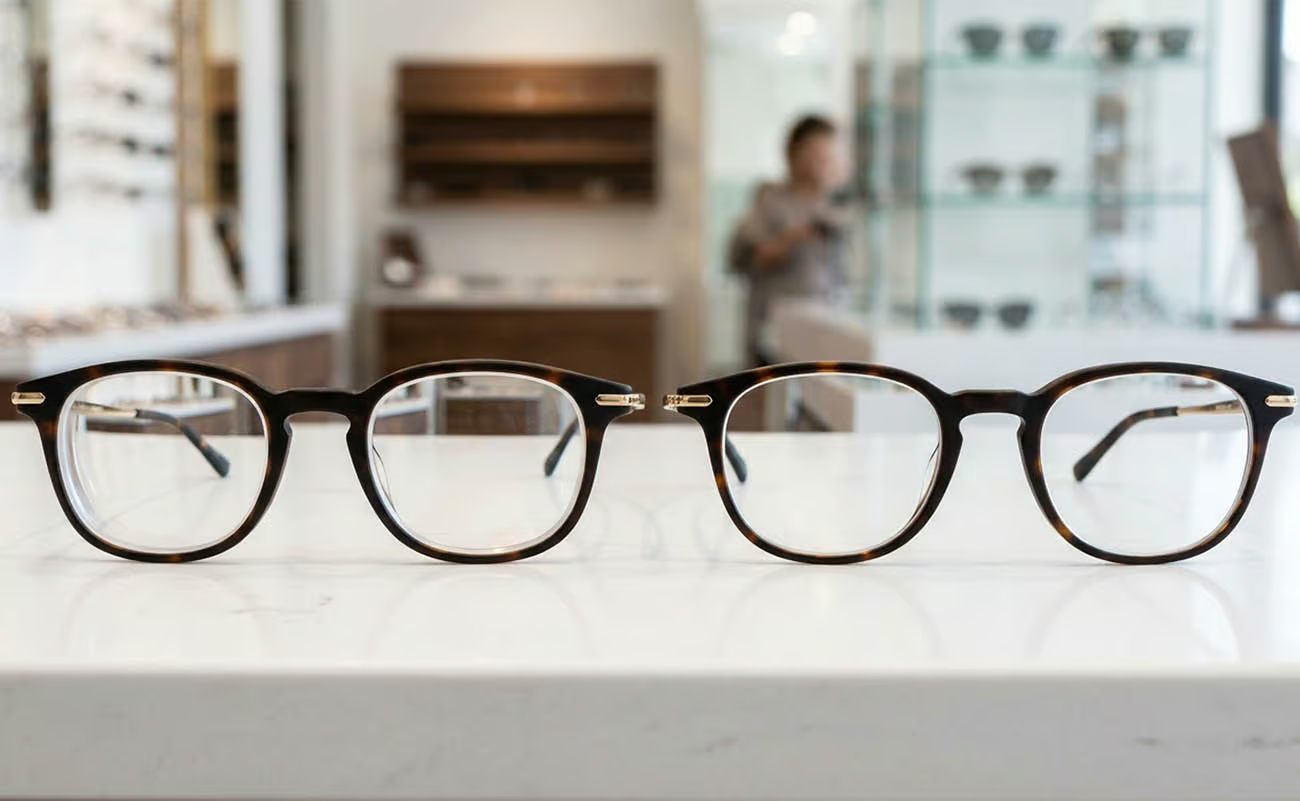
Tokai AS — the aspheric foundation
Tokai’s standard aspheric single-vision lenses (marked “AS”) are available across the index range up to 1.76, with wide prescription ranges in Tokai’s UAE range — up to around −20.00D in some index and design combinations. For most medium prescriptions, an AS lens in the right index is the sensible starting point: thinner and flatter than a spherical lens, without moving to the premium design tiers.
- Main benefit: thinner, flatter lens with better edge optics than basic spherical.
- Ideal for: everyday single-vision wearers from moderate prescriptions upward.
- Real-life example: a −4.50 wearer replacing chunky standard lenses gets a noticeably slimmer, lighter pair in 1.60 or 1.67 AS.
- Consider: at low powers the visual difference vs spherical is small; your optometrist will tell you honestly whether it is worth it.
- Available in: indexes 1.50–1.76, and in Lutina and Transitions versions. Coating options depend on the index chosen.
Tokai HR — High Resolution, back-surface aspheric
HR stands for High Resolution, and it is Tokai’s next-generation back-surface aspheric single-vision design — the aspheric shaping is applied to the inner surface of the lens, the side closest to your eye.
What makes HR different is where it aims the light. Inside your retina is a tiny spot called the fovea centralis — the point of sharpest vision, which sits slightly toward the ear side rather than dead centre. Whenever you look at something, your eye automatically swings it onto that spot. Tokai designs the HR surface around that real behaviour, steering light to concentrate where your sharpest vision actually is, instead of assuming you always look straight through the middle of the lens.
HR also corrects aberrations for both eyes working together rather than treating each lens on its own, which is what keeps side vision comfortable when you glance left or right without turning your head.
HR is built in two purpose-specific distance designs. The regular-use type prioritises clear far vision — driving, shopping, general wear. The near-vision type is made exclusively for close work: desk tasks, reading and phone use. This is the difference the “(N)” marks — a design tuned to a different working distance, not a higher or lower grade of lens. Choosing between them is a conversation about what these particular glasses are for.
Two personalisation options can be added: i Location Remix, which adjusts the design to the real three-dimensional position of the lens in front of your eye (wrap angle, tilt and the distance from lens to eye), and front curve select, which matches the lens curve to your frame’s curve so the lens sits neatly in the frame instead of bulging out of it.
- Main benefit: more natural, stable vision across the lens, especially as prescriptions get stronger or more complex.
- Ideal for: higher or complicated prescriptions, significant astigmatism, and wearers sensitive to the “swimming” feeling at lens edges.
- Real-life example: an office worker with −6.00 and −1.75 astigmatism who notices blur when glancing at a second monitor may see steadier side vision with HR than with a basic aspheric.
- Consider: benefits show best with accurate personalised measurements; a rushed fitting wastes the design.
- Available in: 1.60, 1.67, 1.70 and 1.76, plus Transitions and Lutina versions.
Tokai HR-W — the same High Resolution technology, on both surfaces
HR-W is the step up. Tokai takes the same High Resolution clear-vision technology (which Tokai calls “Hi-ResTech”) and applies aspheric shaping to both surfaces of the lens instead of only the back one. The result, in Tokai’s words, is a natural field of view with extremely little distortion and blurring.
Splitting the optical work across two surfaces does two things at once. The front surface uses a dedicated aspheric design that allows a flatter lens — and Tokai sets the best curve for each power, automatically adjusting if your right and left eyes need different powers. The back surface is then made to order after your prescription arrives, individually optimised to your power, curve, thickness and lens size, with correction applied in every direction around the lens rather than just top-to-bottom.
That last point is the real difference between an off-the-shelf aspheric and HR-W: the back surface is not a standard shape your prescription is fitted into — it is calculated for your lens, including your astigmatism and the size the lens will be cut to for your frame.
These are two different kinds of choice, not two rungs of one ladder. HR(N) is HR tuned for a different working distance — near instead of general use. HR-W is a higher technology level: both lens surfaces shaped, made to order for your exact prescription and lens size. You can want near-focused optics without wanting to move up to double-sided, and the other way round. We match this to your prescription and to what the glasses are actually for.
HR-W is offered in two characters: Clearly, which prioritises the clearest, most natural field of vision, and Shapely, which prioritises thinness — combined with 1.76, Tokai’s highest-index material, this is where the flattest, slimmest result comes from. A Clearly Near (CN) version is also available for wearers who want the double-sided design specifically for close work.
- Main benefit: Tokai’s most refined single-vision optics — maximum thinness and edge-to-edge clarity, particularly in 1.76.
- Ideal for: strong prescriptions where both appearance and optical quality matter; wearers upgrading from lenses that felt “warped” at the edges.
- Real-life example: a −9.00 wearer combining HR-W with the 1.76 material gets close to the thinnest, most natural-looking result currently possible in a plastic lens.
- Consider: premium pricing; the visible thickness benefit vs HR is greatest at higher powers and in well-chosen frames.
- Available in: 1.60, 1.70 and 1.76, plus Lutina versions including 1.50 Lutina.
Also in the Tokai range at Optic One: Bi-Aspheric (GO) double-surface aspheric lenses — with 1.76, Tokai states up to 50% thinner than conventional plastic lenses — and CVf, a custom-made double-sided aspheric design that compensates for wrapped, curved frames and matches the two lenses as a pair. Ask us when these fit your frame and prescription better than HR or HR-W.
Tokai Lutina: an eye-protective lens material
Lutina is a lens material, not a coating. The protective function is built into the lens itself. Launched by Tokai in 2014, Lutina is designed to filter high-energy violet light (HEV) — the 400–420 nm band that sits just beyond ordinary UV. According to Tokai’s product information, Lutina cuts approximately 94% of HEV light in that range, while keeping lens coloration to a minimum.

Why 400–420 nm? The lutein connection
Lutein is a yellow carotenoid pigment that sits in very high concentration at the macula — the small central part of the retina you rely on for sharp, detailed vision. Together with a related pigment, zeaxanthin, it forms what is often called the eye’s macular pigment. It does two jobs at once: it absorbs high-energy short-wavelength light before that light reaches the delicate photoreceptors, and it behaves as an antioxidant, helping the eye cope with the oxidative stress that light and normal metabolism create.
Here is the part most people don’t know: the human body cannot make lutein itself. Every bit of it has to come from the diet — mainly green and yellow vegetables such as spinach, kale and broccoli — and the amount held in the macula tends to decline with age. Anything that adds to the load on that pigment, without a way to replace it, is therefore worth taking seriously.
High-energy violet light in the 400–420 nm band is one such load: Tokai, citing published research, describes it as a contributor to oxidative stress and to the gradual degradation of that pigment. This band sits just above the UV that ordinary lenses already stop, which is exactly why it slips through standard UV protection. Tokai’s stated design goal for Lutina is to filter most of this 400–420 nm light so the eye’s own lutein is put under less strain — the reasoning behind Tokai calling it an “eye care” material. Note the wording carefully: this is about reducing a light load, not treating or preventing any condition (see the note below).
How Lutina differs from UV protection and blue-light coatings
- vs standard UV protection: a lens with proper UV protection stops light up to about 400 nm — worth specifying, and not automatic on every material. Lutina goes above that line, sharply filtering the 400–420 nm HEV band that UV protection alone is not designed to reach. The two work together rather than replacing each other.
- vs blue-light-reflecting coatings (like TBC): a blue-cut coating works by reflecting part of the blue range off the lens surface, which creates a visible bluish sheen. Lutina works inside the material and targets the violet end (400–420 nm) rather than the whole blue range — so, per Tokai, it keeps lens coloration to a minimum and, unlike a heavy blue-cut coating, leaves most of the everyday blue spectrum unaltered.
- You still choose a coating: because Lutina is the material, it is combined with whichever single coating suits you — from PGC up to USC, subject to availability for your design and index. Photochromic Lutina Photo versions that darken in sunlight are also available.
Who should consider Lutina?
Lutina makes most sense for people with high daily light and screen exposure — outdoor lifestyles under the UAE sun, long office screen hours, and anyone who simply wants the protective option built into a premium lens. In the Optic One range, Lutina is available across single vision (including HR, HR-W and Bi-Aspheric designs), Neuro Select progressives, indoor designs and photochromic Lutina Photo, in indexes from 1.50 to 1.76 depending on design.
Spectacle lenses — including Lutina — are not a treatment or prevention for any eye disease, and filtering claims relate to light transmission, not medical outcomes. Regular comprehensive eye examinations remain the most important thing you can do for long-term eye health. If you have a family history of retinal disease, tell us during your consultation.
Tokai Neuro Select progressive lenses
Neuro Select is Tokai’s progressive lens family, designed and evaluated using neuroscience — Tokai measures brain responses with EEG, MEG and fNIRS to assess how visually comfortable a design actually feels while worn, rather than judging it on optical simulation alone. At Optic One the range covers grades 3, 5, 5X, 7X and 9X, in Daily and Town designs, with Home (indoor-focused) designs offered in selected grades.

First: what is a progressive lens?
A progressive lens gives you clear vision at all distances in one lens — far at the top, reading at the bottom, and everything between — with no visible line. The trade-off is that every progressive design has soft zones toward the lower edges where vision blurs slightly. Cheaper designs have narrower clear zones and more “sway” when you move your head; better designs widen the clear zones and calm the movement. This is exactly where design quality earns its money.
The grades available at Optic One
| Grade | Tokai’s positioning | Best suited to |
|---|---|---|
| Neuro Select 3 | Basic grade of the neuroscience family (back-surface progressive) | First progressive, straightforward prescriptions, budget-conscious entry into Tokai |
| Neuro Select 5 | Standard grade, back-surface progressive design | Everyday wearers wanting a comfortable, proven all-rounder |
| Neuro Select 5X | High grade with additional design optimisation | Wearers stepping up for wider, calmer vision without the top-tier price |
| Neuro Select 7X | Premium grade with double-sided progressive design | Demanding daily wearers; people who found earlier progressives limiting |
| Neuro Select 9X | Tokai’s top, super-premium grade | Maximum personalisation — complex prescriptions, previous adaptation problems, no-compromise wearers |
What the design technologies actually do
- N-style Binocular Link Design: the right and left lenses are designed as a linked pair, so both eyes receive matching images — supporting clearer, sharper combined vision.
- Variable Zone Control: balances the near-vision zones when your right and left eyes have different powers — a common, underestimated cause of progressive discomfort.
- Dedicated Multi Optima System: optimises the progressive surface based on your distance power and reading addition together, improving the far-vision zone.
- i Location Remix: adjusts the design to the real three-dimensional position of the lens in front of your eye — frame wrap, tilt and the distance from lens to eye.
- My Tune Engine: uses your frame shape and eye-point data to minimise sway, distortion and blur for your exact frame.
- My Feel Select 2: lets the design be tuned to your visual preference — Tokai’s options include Mild, Clear, New Balance and Wide characters.
Daily, Town and Home designs
Most Neuro Select grades come in three lifestyle designs: Daily (distance-priority — driving, sport, general outdoor use), Town (intermediate-emphasis — shopping, meetings, in-town life) and Home (a mid/near indoor design with a wide, deep field for office and home). Choosing between them is a conversation about how you actually spend your day — which is why we ask so many questions before recommending one.
Will progressives work in my frame?
Usually yes, because Tokai builds Neuro Select in a range of corridor lengths — from 11 mm up to 17 mm for Daily and Town designs, and 21–23 mm for the wider Home designs. The corridor is the vertical distance your eye travels from distance vision down to full reading power. A shorter corridor lets a progressive work in a smaller, shallower frame; a longer corridor gives a smoother, more gradual transition in a deeper frame.
What this means in practice: a small frame does not automatically rule out progressives, but it does narrow your design options, and we measure before promising anything. Bring the frame you like and we will tell you honestly whether it will work.
Real situations we fit Neuro Select for
- The first-time progressive wearer who is nervous about “getting used to them”: we usually start with a well-fitted 5 or 5X, set expectations honestly, and review after two weeks.
- The office worker on multiple screens: Town or Home designs, or an indoor Tokai lens as a second pair, keep intermediate vision wide where they actually look.
- The regular driver: a Daily design with a stable distance zone.
- Different prescriptions in each eye: this is where Variable Zone Control and the binocular design approach genuinely matter — worth stepping up a grade.
- The person who “failed” progressives before: we re-measure everything, find out what went wrong (often fitting height or frame position, not the wearer), and typically recommend 7X or 9X with full personalisation.
One promise we will not make: instant adaptation. Most wearers adapt to a well-fitted progressive within days to a few weeks, but this varies from person to person, and no manufacturer can guarantee it. What we can control is the part that most often causes failure — accurate measurements and the right design for your day. Tokai also backs its progressives with a 30-day non-tolerance guarantee on most designs, explained in the warranty section below.
Considering progressives? Visit Optic One on Hamdan Street for professional measurements — the design is only as good as the fitting behind it.
Which Tokai lens coating should I choose?
You choose one coating for your lenses. Pick USC for maximum durability and smudge resistance, NRC for the lowest visible reflection on camera, ESC for UV and near-infrared sun protection, TBC for a blue-light option, or SPS for durable everyday value. Which coatings are actually available depends on your lens design, index and material — so the shortlist is narrowed at your consultation.
A lens coating is a set of ultra-thin layers applied to the lens surface. It controls how much light reflects off the lens, how easily it scratches, and how it handles water, oil and dust. The coating does not change your prescription — it changes how the lens survives daily life and how it looks on your face. Tokai produces its coatings in its own thin-film division, and three of them are worth understanding properly.
Coatings are not stacked on top of each other: NRC and ESC are alternatives, not a combination. What you can combine is the lens material with your chosen coating — for example Lutina material with the coating that suits your habits. Coating availability varies by lens technology, index and material, so we confirm what is possible for your exact prescription before you decide.
Which lens coating shows almost no reflection on camera?
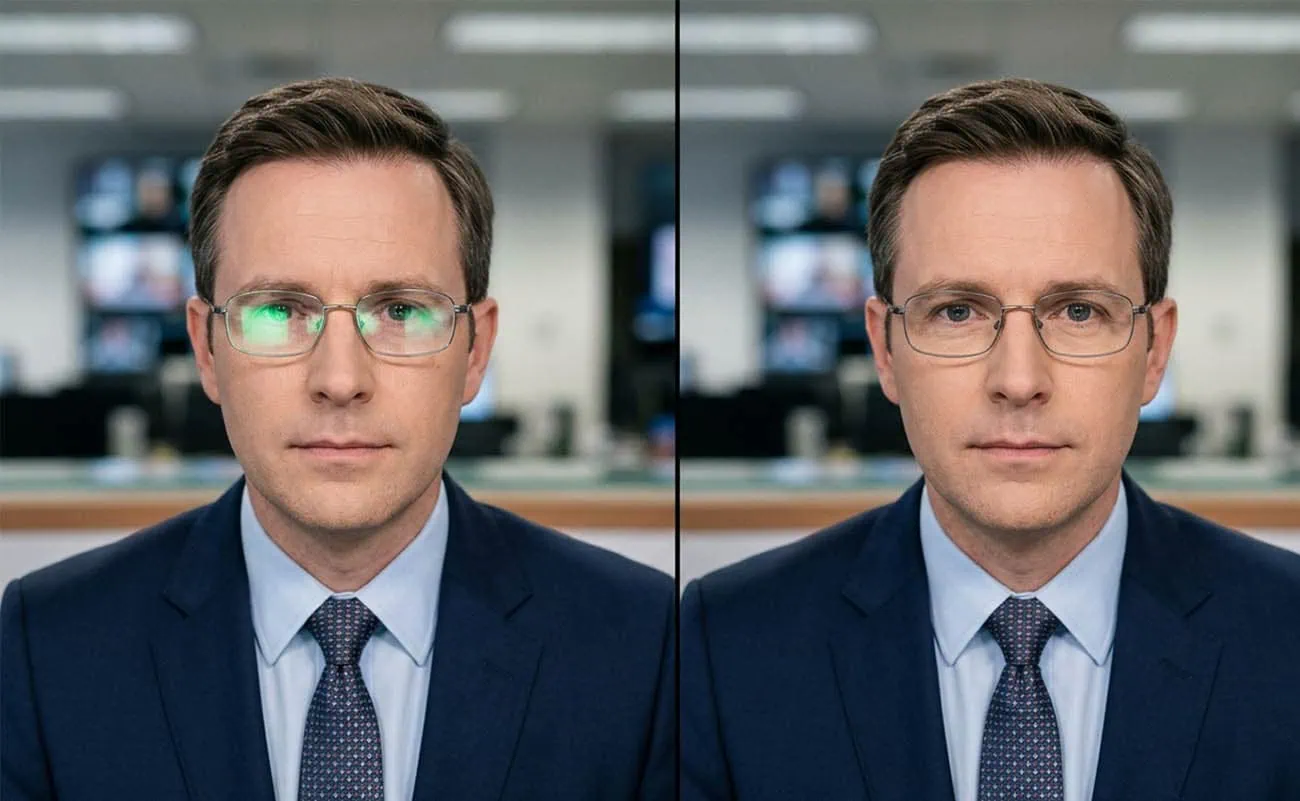
Tokai’s NRC (No Reflection Coating) has a sensed reflectance of approximately 0.19% — a level Tokai describes as world-leading. Under studio lights, on video calls and in photographs, the lens surface looks close to invisible, so people see your eyes rather than green or blue flashes across your glasses. It suits presenters, news readers, content creators, and anyone regularly on camera.
How it works, and who it is really for
Every anti-reflective coating leaves a residual reflection — the faint green or blue sheen you see on most glasses at an angle. NRC, launched by Tokai in 2021, pushes that residual reflection down to roughly 0.19% (a measured value on 1.60 index). In practice the front of the lens shows minimal white rings, ghost rings or colour cast.
That matters most when a light source is pointed at your face. Broadcast key lighting, ring lights, conference-room downlights and camera flash all produce exactly the reflections that hide your eyes. If your work involves being looked at through a lens — presenting, teaching, recording, interviews, video meetings all day — this is the single coating choice that changes how you appear.
Also included, per Tokai: approximately 13% blue-light reduction, plus scratch-resistant, ultra-water-repellent and anti-static properties as standard.
- Best for: presenters, news readers, vloggers, lecturers, anyone in daily video calls, and wearers who dislike how their glasses photograph.
- Real-life: in photographs and on video, ordinary coated lenses show green or blue flashes; NRC keeps your eyes visible with almost none.
- Honest limitation: premium price, and availability varies by lens design and index. Frame tilt can also create reflections no coating can fix — we check that at fitting.
- Not for you if: you are rarely photographed and your priority is surviving a tool bag. USC serves you better.
Which lens coating protects against infrared and the skin around your eyes?
Tokai’s ESC (Eternal Skin Coating) blocks UV and, uniquely in Tokai’s coating range, cuts approximately 50% of near-infrared light in the 760–1400 nm band. Near-infrared penetrates deeper into skin than UV does, so Tokai positions ESC as protection for both the eyes and the delicate skin around them. Chosen on Lutina material, it gives layered coverage: violet light filtered inside the lens, UV and near-infrared handled at the surface.
What ESC adds on top of UV protection
First, a point worth understanding properly, because it is widely assumed and often wrong: UV protection is something you specify, not something you can take for granted. How much UV a lens stops depends on the material it is made from and on what is ordered with it. Higher-index materials — 1.60 and above — absorb UV up to around 400 nm as an inherent property of the material. Standard 1.50 material does not do this on its own; it reaches full UV-A protection only when a UV-absorbing specification is included. There is also a second question most people never think about: light arriving from behind you and bouncing off the back surface of the lens into your eye, which is what Tokai’s back-surface UV options and USC’s 360° UV protection are designed to deal with. Ask us what your lens actually does — it is a real difference, not a formality.
So UV protection is worth having and worth checking. What makes ESC distinct within Tokai’s range is that it goes a step further, into a band nothing else in the range addresses: near-infrared.
Near-infrared is the part of sunlight you feel as heat. It sits beyond the visible spectrum and beyond UV in wavelength, and it penetrates further into skin tissue than UV does. In a climate like the UAE’s, where you may be in direct sun or facing low sun through a windscreen for hours a day, reducing that load is a reasonable thing to want from a clear everyday lens.
The layered protection combination
This is where Tokai’s structure becomes genuinely useful. Because Lutina is a material and ESC is a coating, one lens can do both jobs at once:
- Inside the lens (Lutina material): approximately 94% of high-energy violet light, 400–420 nm, filtered by the material itself.
- At the lens surface (ESC coating): UV blocked, plus approximately 50% of near-infrared, 760–1400 nm, reflected away.
For a driver, an outdoor worker, or anyone who spends real time in UAE daylight, that is the most complete light-protection package available in a clear lens rather than a sunglass. Availability depends on the lens design and index you need, so we confirm it before ordering.
- Best for: long daily driving, outdoor work, high sun exposure, and anyone who wants protection without moving to a tint.
- Real-life: a commuter facing low sun both ways chooses ESC on a Lutina lens rather than carrying a second pair of sunglasses everywhere.
- Honest limitation: these are Tokai’s published light-transmission figures under Tokai’s test conditions — not a promise of any cosmetic or medical outcome. No coating prevents skin ageing or eye disease.
Which Tokai coating is the most scratch-resistant?
USC (Ultra Shield Coating) is Tokai’s flagship durability coating. In Tokai’s own scratch-manifestation testing, which simulates real daily wear and cleaning, USC showed approximately six times the scratch resistance of a conventional multicoat. It adds high water and oil repellence, anti-static dust resistance, and 360° UV protection including light reflecting off the back surface of the lens. At Optic One, USC-coated lenses also come with a 6-month warranty against scratches in the UAE — a one-time replacement — on top of Tokai’s 1-year guarantee against manufacturing defects.
Why scratch resistance is the upgrade most people actually need
Scratches are the most common reason a good pair of lenses stops being good. They rarely come from one dramatic event — they accumulate from lenses going face-down on a desk, sliding around in a bag with keys, being wiped on a shirt hem, or sitting on a hot dashboard collecting dust and then being rubbed clean.
USC targets exactly that pattern. Tokai’s testing method is designed to simulate daily handling rather than a single laboratory abrasion, which is why the resulting figure is worth paying attention to. Add the fluorine-based repellence and anti-static behaviour and the lens both resists marking and needs less rubbing in the first place — which is itself a large part of why lenses scratch.
USC-coated lenses ordered through us carry a 6-month warranty against scratches in the UAE, covering a one-time replacement of the affected lenses. It is cover we do not offer on every coating, because USC is the one built to withstand this. Separately, Tokai gives a 1-year guarantee against manufacturing defects. Terms and eligibility apply; we confirm the exact cover with your order.
- Best for: anyone keeping their lenses for years, previous “I scratched them in three months” cases, active and outdoor wearers, and premium builds where durability should match the lens inside.
- Real-life: if your last pair came out of a bag scratched, USC is the single most effective choice you can make on the next pair.
- Honest limitation: highly scratch-resistant is not scratch-proof. Dropping lenses face-down on stone will still leave marks. Clean with water and a microfibre cloth, never a shirt.
The rest of the Tokai coating range
Three more coatings complete the range. They are real products with real strengths — they simply answer more ordinary questions than the three above.
- PGC — ProGuard Coating. Tokai’s standard anti-reflective multicoat. Reduces surface reflections and repels smudges. The sensible default on a value pair.
- SPS — Super Power Shield. A scratch-focused anti-reflective multicoat with fluorine-based water and oil repellence. The workhorse coating across much of the Tokai stock range — durable everyday value.
- TBC — Technical Blue Coating. Reflects part of the blue range — Tokai states about 15% of blue light around 450 nm, the strongest peak from LED screens. The residual reflection is blue rather than green, which is more noticeable in photos.
Coating comparison at a glance
This is an editorial comparison prepared by Optic One based on Tokai’s published specifications — Tokai does not publish an official star-rating system. “—” means the feature is not a stated function of that coating.
| Coating | Best for | Reflection control | Scratch resistance | Additional protection | Level |
|---|---|---|---|---|---|
| PGC ProGuard | Value everyday wear | Standard anti-reflective | Standard | — | Standard |
| SPS Super Power Shield | Durable daily use | Standard anti-reflective | High (strengthened multilayer) | — | Standard+ |
| TBC Technical Blue | Screen-heavy days | Anti-reflective, blue residual sheen | Standard | Cuts ~15% of blue light around 450 nm | Standard+ (digital) |
| NRC No Reflection | Cameras, video calls | Ultra-low — ≈0.19% sensed reflectance | High (standard feature) | ~13% blue-light reduction | Premium |
| ESC Eternal Skin | Sun-heavy lifestyles | Anti-reflective | Standard | UV block + ~50% near-infrared cut, 760–1400 nm | Premium (protection) |
| USC Ultra Shield | Long-term durability | Anti-reflective | Highest in range (~6× conventional multicoat) | 360° UV incl. back-surface reflection · 6-month replacement warranty at Optic One | Flagship |
Remember: not every coating is available on every lens design and index, and the most expensive coating is not automatically the right one for you. A camera-shy heavy-screen user and a construction supervisor need different coatings on identical prescriptions. Mirror finishes, tints and colour options are also available on selected designs.
Tokai vs ZEISS, Hoya and Essilor: an honest comparison
There is no single best lens brand. At Optic One we fit all four, so our honest summary is this: Tokai leads on the thinnest plastic material and coating durability, ZEISS on measurement technology and brand assurance, Hoya on progressive design breadth and value at the mid tier, and Essilor on photochromic technology and the widest global availability. The right brand depends on your prescription, your priorities and your budget.
| Brand | Where it leads | Where others may suit you better |
|---|---|---|
| Tokai | The 1.76 material — the highest-index plastic available; coating durability and the ultra-low-reflection NRC; deep aspheric design ladder; neuroscience-based progressive personalisation | Smaller brand presence and fewer retail touchpoints than the global names |
| ZEISS | Measurement and fitting technology, strong brand recognition and reassurance, well-developed premium progressive range | Not the thinnest material at very high powers |
| Hoya | Broad progressive portfolio with strong value at the middle tiers, well-regarded coatings | Fewer specialist protective material options |
| Essilor | Photochromic technology and the widest availability worldwide — useful if you travel and may need service abroad | Premium tiers can price close to the specialists without the same material edge |
Where we genuinely recommend Tokai: strong prescriptions where thickness is the main complaint, wearers who care how their lenses photograph, people who have scratched previous lenses quickly, and progressive wearers who have failed to adapt before. Where we might not: straightforward low prescriptions, where the premium tier of any brand adds cost without visible benefit — and we will say so.
This comparison reflects our own fitting experience across these brands. Specifications and ranges change; we confirm current availability at the time of your order.
Tokai warranty and lens care
Tokai lenses carry a 1-year guarantee against manufacturing defects. At Optic One, USC-coated lenses also carry a 6-month warranty against scratches in the UAE, covering a one-time replacement. Tokai gives a 1-year breakage warranty on 1.60 Tokai-branded index lenses, and a 30-day non-tolerance guarantee on progressive lenses — so if you genuinely cannot adapt to a progressive, there is a defined route to resolve it.
What each guarantee covers
- Manufacturing defect guarantee. One year against manufacturing defects. Damage from mishandling is not covered.
- USC scratch warranty at Optic One. Six months against scratches on USC-coated lenses supplied by us in the UAE, covering a one-time replacement. Terms and eligibility apply.
- Breakage warranty. One year on 1.60 Tokai-branded index lenses.
- Progressive non-tolerance guarantee. Valid for 30 days from dispatch of the original order, on all progressive designs except BS Standard and BS PM. This is the manufacturer’s answer to “what if I can’t get used to them?” — we explain how it works before you order.
Looking after your lenses in the UAE
One care instruction matters more here than almost anywhere else. Tokai specifies that lenses should not be exposed to temperatures above 60°C. A car dashboard in an Abu Dhabi summer routinely exceeds that. Heat damage to a lens coating is not a manufacturing fault and is not covered by any guarantee — so the glovebox, not the dashboard.
- Rinse with clean water before wiping, then use a microfibre cloth — never a shirt, tissue or paper towel.
- Do not clean with household detergents.
- Keep lenses away from hairspray and aerosol sprays.
- Store in a case face-up, never lens-down on a hard surface.
“Which Tokai option is for me?” — real scenarios
“My prescription makes my lenses look thick.”
Likely issue: a strong power in a standard-index lens, often in a frame that amplifies edge thickness. Worth discussing: 1.67, 1.70 or 1.76 index with HR or HR-W aspheric designs. Why: Tokai’s 1.76 is up to 49% thinner than 1.50 per Tokai’s data, and double-sided aspheric design flattens the lens further. We still check: frame size and shape, your pupil distance relative to the frame, and whether the thinnest option is actually worth its price at your specific power.
“I’m on camera every day and my glasses reflect.”
Likely issue: a standard anti-reflective coat still leaves a visible green or blue sheen under directional lighting. Worth discussing: NRC. Why: at roughly 0.19% sensed reflectance, it removes almost all visible surface reflection, so your eyes stay visible on camera. We still check: whether NRC is available on the design and index your prescription needs, and whether frame tilt is adding reflections a coating cannot fix.
“I spend most of my day in front of screens.”
Likely issue: long hours of near focus and artificial light — often more a focusing workload issue than a “blue light” issue. Worth discussing: Lutina material, or the TBC coating; for progressive wearers, a Town or Home design or a dedicated indoor pair. We still check: your working distances, and whether uncorrected astigmatism or an outdated prescription is the real cause of tired eyes.
“I drive long distances in strong sun.”
Likely issue: hours of high UV and infrared exposure through glass, plus glare fatigue. Worth discussing: ESC coating on a Lutina lens; a Neuro Select Daily design if you need progressives; photochromic Lutina Photo if you want the lens to darken outdoors. We still check: your night-driving comfort separately, because that depends on prescription accuracy rather than sun protection.
“I scratched my previous lenses within months.”
Likely issue: a basic hard coat meeting real life — bags, dashboards, dry wiping. Worth discussing: USC — the most scratch-resistant coating in the Tokai range, and the 6-month replacement warranty we give with it. We still check: how the scratches happened — storage and cleaning habits — because no coating is scratch-proof.
“I don’t know which upgrades are worth it.”
Our honest rule: spend first on the right design for your prescription, second on the right index for thickness, third on the coating that matches your habits — and skip upgrades that duplicate each other. Worth discussing: one well-chosen combination, not the longest list of extras. We still check: your budget honestly against where each dirham changes what you actually see and feel.
“I drive, work at a computer and read all day.”
Likely issue: one pair being asked to do three jobs. Worth discussing: a Neuro Select Daily as the main pair, with a second task-specific pair — an indoor or office design — for desk work. Why: two purpose-built pairs beat one compromise pair. We still check: your dominant tasks and hours, so the main pair matches the majority of your day.
Also available to order from the Tokai range
Tokai’s UAE range is considerably wider than the designs above. Almost all prescription lenses are made to order rather than held in stock — typically around 10 to 14 days depending on the lens — so if you need something specific, ask. All of the following are available to order at Optic One in Abu Dhabi.
- Myogen — myopia control lenses for children. Tokai’s myopia management lens, built around an original honeycomb lens structure designed to slow the progression of myopia by influencing how the eye lengthens. Available in 1.60 and 1.70 index.
- Tokai Polar — prescription polarised sunglasses. Polarised prescription lenses in 14 colours, with mirror finishes on selected options, across single vision, HR aspheric and EasyOne progressive designs. Genuinely useful in UAE glare conditions.
- REST S, REST R and REST W Plus — eye-assist lenses. Single-vision lenses with a small built-in assist power (four grades from +0.50 up to +1.25) designed to reduce focusing effort during long screen sessions. Aimed at people who are not yet presbyopic but work at screens all day — a different answer from a blue-light filter.
- Night Drive. A dedicated design for night driving, available as a 1.60 single-vision lens and as a progressive.
- Indoor Neo and BS Indoor — office and indoor designs. Three variants tuned to different working distances: Extra (mid-range around 3 m), Long (around 2 m) and Wide (around 1 m, widest near field). Chosen by how far away your screen actually sits.
- 1.76 Biconvex — very high plus powers. Covers up to +20.00D, relevant for post-cataract and other high-plus prescriptions where standard ranges run out.
- Medical filter lenses (CCP). Specialist filter options for particular clinical needs, assessed case by case.
- Bifocal C28. Traditional bifocals, still available in 1.50 and 1.60 for wearers who prefer them.
- Classic progressive designs. BS Standard, Sereno, EasyOne, Energy and Modecinq sit below Neuro Select — a more accessible route into a Tokai progressive, including EasyOne’s wrap-angle compensation for curved frames and Energy’s short 9 mm corridor built around digital device use.
If you need something specific and you are not sure whether it exists, ask us — Tokai’s UAE range is wider than any one page can usefully cover, and we will check availability for your prescription before you commit to anything.
How Optic One helps you choose the right Tokai lens
Everything above narrows the options — it cannot make the final call. The right Tokai lens for you depends on factors we measure and assess in person:
- Your prescription and lens power — design and index recommendations change significantly with power and astigmatism.
- Frame size, shape and position — the same lens performs differently in a large acetate frame and a small metal one; wrap and tilt change the optics.
- Fitting height and pupil distance — measured precisely, per eye, for the specific frame; this is where progressive success is decided.
- Lifestyle and screen hours — what you look at, at what distance, for how long.
- Previous lens experience — what worked, what failed, and why.
- Appearance preferences and budget — we tell you honestly where extra spend stops adding visible benefit for your power.
Optic One is a clinically led, DOH-licensed optical practice — our role is to prescribe and fit the right lens, not simply to sell the most expensive one. If a mid-range Tokai combination serves you better than the flagship, that is exactly what we will recommend.
Buy one complete pair with Tokai lenses — get a second complete pair free
Valid until July 30, 2026 at Optic One, Hamdan Street, Abu Dhabi.
Choose a complete pair with Tokai lenses and receive a second complete pair free. It is a rare chance to solve two needs at once. Popular ways customers use the second pair:
- A backup pair — because losing or breaking your only glasses is always urgent.
- A dedicated work pair — for example an office or indoor design alongside your everyday progressives.
- A different style — a professional frame and a casual one.
- Sun or light-adaptive options — where eligible for your prescription and lens selection.
Terms and eligibility apply. Contact Optic One to confirm the available Tokai lens options for your prescription.
Tokai lenses — frequently asked questions
Are Tokai lenses available in Abu Dhabi?
Yes. Tokai lenses are available at Optic One Opticals on Hamdan Street, Abu Dhabi, supplied through Tokai’s official UAE distribution. We supply the current UAE Tokai range including single-vision, Neuro Select progressive, Lutina and photochromic options, fitted after an in-store eye test and measurements.
Are Tokai lenses Japanese?
Yes. Tokai Optical is a Japanese company founded in 1939, with its headquarters and main lens production in Okazaki, Japan. Tokai supplies the UAE through its official Middle East operation.
What are Tokai aspheric lenses?
Tokai aspheric lenses use flatter, refined surface curves instead of a simple spherical curve, which makes lenses thinner at the edge and keeps vision more natural away from the lens centre. Tokai offers several levels: standard aspheric (AS), back-surface aspheric (HR, which stands for High Resolution), and double-sided aspheric designs (HR-W and Bi-Aspheric).
What is Tokai Lutina?
Lutina is a Tokai lens material designed to filter high-energy violet light (400–420 nm) — about 94% of it, according to Tokai’s product information — with the aim of easing the light load on the eye’s natural lutein pigment. It keeps any lens colour to a minimum and is available across most Tokai designs at Optic One.
Is Lutina a coating?
No. Lutina is a lens material — the light-filtering function is built into the lens itself, not applied to its surface. You still choose one coating separately, such as SPS, TBC, NRC or USC, subject to what is available for your lens design and index.
Can Tokai coatings be combined?
No. You choose one coating for your lenses — NRC and ESC, for example, are alternatives rather than a combination. What can be combined is the lens material and the coating: Lutina material can be ordered with whichever single coating suits you. Available coatings vary by lens technology, index and material, so we confirm the options for your exact prescription.
What are Neuro Select progressive lenses?
Neuro Select is Tokai’s progressive lens family, designed and evaluated using neuroscience — Tokai measures brain responses to assess visual comfort and reduce blur, distortion and sway. At Optic One the range covers grades 3, 5, 5X, 7X and 9X, in Daily and Town designs, with Home indoor designs in selected grades.
Which Tokai coating is best?
There is no single best — it depends on your habits. USC is the flagship for durability, NRC for near-invisible low reflection, ESC for UV and near-infrared sun protection, TBC for a blue-light option, and SPS for durable everyday value. We match the coating to how you actually use your glasses.
Which Tokai coating is the most scratch-resistant?
USC (Ultra Shield Coating). In Tokai’s own scratch-manifestation testing it showed approximately six times the scratch resistance of a conventional multicoat, and at Optic One it is the coating we back with a 6-month scratch warranty in the UAE, covering a one-time replacement. It is highly scratch-resistant — but no lens coating is scratch-proof.
Which Tokai coating has the least visible reflection?
NRC (No Reflection Coating). Tokai reports a sensed reflectance of roughly 0.19%, which makes the lens surface look almost invisible — a clear advantage in photographs, on video calls and under studio lighting. It is the coating we recommend for presenters, news readers and content creators.
Which lens coating blocks infrared light?
ESC (Eternal Skin Coating) is the coating in Tokai’s range that addresses near-infrared. Per Tokai, it blocks UV and cuts approximately 50% of near-infrared light in the 760–1400 nm band, which penetrates deeper into skin than UV does. Ordered on Lutina material, it gives layered protection across violet, UV and near-infrared.
Does Tokai make myopia control lenses for children?
Yes. Tokai’s Myogen is a myopia control lens available to order in 1.60 and 1.70 index. It uses an original honeycomb lens structure designed to slow the progression of myopia by influencing how the eye lengthens. Contact us to discuss whether it suits your child’s prescription.
Are Tokai polarised prescription sunglasses available?
Yes. Tokai Polar prescription polarised lenses are available to order in 14 colours, with mirror finishes on selected options, in single vision, HR aspheric and EasyOne progressive designs. Ask us which colour and design suit your prescription and how you will use them.
Can Tokai lenses be made for strong prescriptions?
Yes — strong prescriptions are a Tokai speciality. The UAE range covers powers up to around −20.00D in certain aspheric designs, and up to +20.00D in the 1.76 Biconvex design. The 1.76 material, the highest-index plastic lens material available, keeps even strong powers comparatively thin. Exact feasibility depends on your full prescription, so we confirm after checking it.
What is the Tokai lens warranty?
Tokai gives a 1-year guarantee against manufacturing defects, plus a 1-year breakage warranty on 1.60 Tokai-branded index lenses. At Optic One, USC-coated lenses also carry a 6-month warranty against scratches in the UAE, covering a one-time replacement. Progressive lenses carry a 30-day non-tolerance guarantee on most designs. Terms apply — ask us to confirm the cover on your order.
Can I use Tokai lenses in my existing frame?
Usually, yes — if your frame is in good condition and suits your prescription and the chosen lens design. Bring the frame in and we will assess it honestly; occasionally a frame’s size, curvature or condition makes new lenses inadvisable, and we will tell you before you commit.
How long do Tokai prescription lenses take?
Selected stock ranges are available quickly, while made-to-order Tokai lenses typically take around 10 to 14 days, depending on the lens design, index and coating you choose. We confirm the expected date when you order.
How should I look after Tokai lenses in the UAE heat?
Tokai specifies that lenses should not be exposed to temperatures above 60°C — which a car dashboard in Abu Dhabi routinely exceeds, so use the glovebox. Rinse with clean water before wiping and use a microfibre cloth, never a shirt or tissue. Avoid household detergents and aerosol sprays. Heat damage is not a manufacturing fault and is not covered by warranty.
How can I order Tokai lenses from Optic One?
Three easy ways: visit Optic One on Hamdan Street, Abu Dhabi for an eye test and fitting; send your prescription via WhatsApp to +971 58 663 6885 for a recommendation; or browse frames at opticone.ae and ask us to pair them with Tokai lenses. Precise fitting measurements are taken in store.
The short version
Tokai in three lines
Tokai earns its reputation in three areas: thin, refined single-vision lenses (high-index materials up to 1.76 with HR and HR-W aspheric designs), the Lutina eye-protective material, and Neuro Select progressives designed with neuroscience. Around all of that sits a coating range — NRC for near-invisible reflection, ESC for UV and near-infrared protection, USC for flagship durability — where you choose the one that matches your life. The best choice is not the most expensive one; it is the one matched to your prescription, frame and day.
That matching is our job.
Ready when you are:
Optic One Opticals · Hamdan Street, Abu Dhabi, UAE · WhatsApp +971 58 663 6885 · DOH licence MF5570
Technical information on this page is based on Tokai Optical’s published product information for its UAE lens range, accessed July 2026. Percentages and comparisons are Tokai’s published figures under Tokai’s test conditions. Warranty terms summarise the manufacturer’s published guarantee; exact cover is confirmed at the time of order. This article is general product information, not medical advice; lens suitability is confirmed only after an eye examination. Promotion valid until July 30, 2026 — terms and eligibility apply.

